
Root Canal Treatment · Keene, TX
Root Canal Treatment in Keene, TX — What to Expect, Step by Step
A root canal has a reputation it doesn't deserve. With modern anesthesia and technology, the procedure feels no more uncomfortable than getting a filling — and it saves your natural tooth. Here's exactly what happens, how long it takes, and why patients say they wish they hadn't waited.
Request AppointmentSigns You May Need a Root Canal
A root canal becomes necessary when the soft tissue inside your tooth — the pulp, which contains the nerve and blood vessels — becomes infected or inflamed. Left untreated, the infection spreads, causes severe pain, and can lead to tooth loss or a dangerous abscess.
Don't ignore these warning signs:
- Severe tooth pain, especially when chewing or biting
- Lingering sensitivity to hot or cold that doesn't fade
- Swollen or tender gums near a specific tooth
- Darkening or discoloration of the tooth
- A pimple-like bump on the gums (fistula)
- Persistent bad taste or odor near the tooth
If you're experiencing any of these, call us. The sooner we treat the infection, the better the chance of saving your tooth — and the faster you'll be out of pain.

The Root Canal Process — Step by Step
The entire procedure takes about 60 to 90 minutes. Most patients are surprised by how straightforward and painless it is.
Exam and X-Ray
We examine the tooth and take digital X-rays to diagnose the infection and map the root structure.
Numbing
Local anesthetic completely numbs the tooth and surrounding area. You'll feel pressure but no pain.
Cleaning
A small opening is made in the crown. Tiny files remove the infected pulp and clean the root canals.
Filling
The cleaned canals are filled with gutta-percha — a biocompatible rubber-like material — and sealed.
Recovery: What to Expect After a Root Canal
Recovery from a root canal is far easier than most patients expect. Here's what the first few days typically look like:
- Day of treatment: Your mouth stays numb for a few hours. Be careful not to bite your cheek or tongue. You can return to work or normal activities immediately
- Days 1–3: Mild tenderness or soreness around the treated tooth is normal. Over-the-counter pain relievers like ibuprofen manage it easily
- Days 3–5: Discomfort fades significantly. Most patients feel completely normal within a week
- Follow-up: You'll return for a permanent crown to protect and strengthen the treated tooth. With our CEREC technology, this can often be done the same day
No bed rest required. Most patients drive themselves home and go back to work the same day. Strenuous exercise is best avoided for the first 24 to 48 hours.
Not sure whether you need a root canal or an extraction? Read our detailed comparison: Root Canal vs. Extraction — How to Decide →
Your Complete Guide to Root Canal Treatment
A visual overview covering warning signs, the step-by-step process, recovery, and common questions.
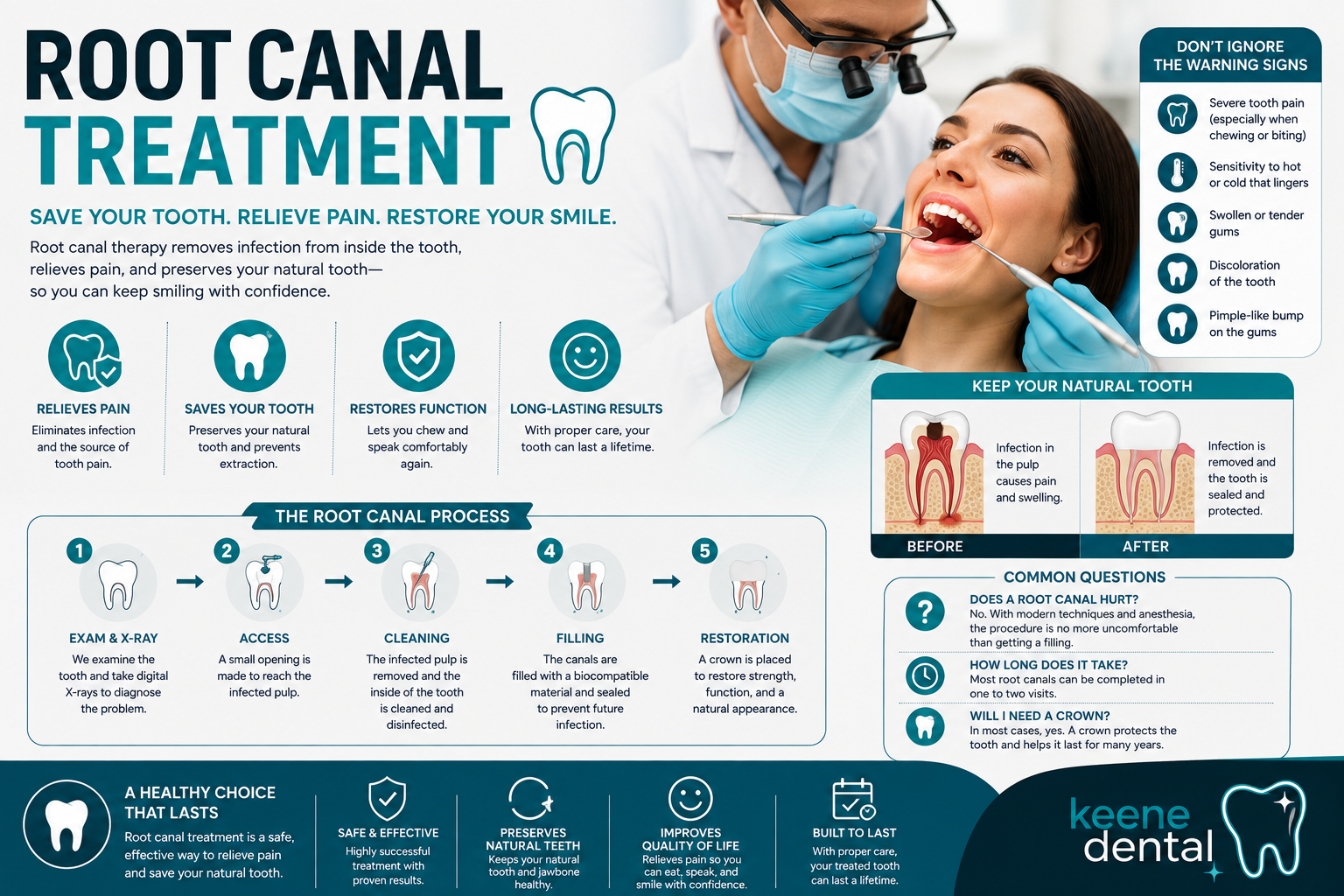
Click the infographic to enlarge
Why Patients Choose Keene Family Dentistry for Root Canals
- Same-day crowns with CEREC — when your root canal needs a crown, we can design and place it the same visit. No temporary, no second appointment
- Nitrous oxide sedation available for patients with dental anxiety
- Digital X-rays for precise diagnosis with minimal radiation exposure
- Honest assessment — we'll tell you when saving the tooth is the right call, and when extraction would serve you better
- Flexible financing through our patient financing options
- Serving Keene, Burleson, Cleburne, and Alvarado — 428 S. Old Betsy Rd., Suite C, Keene, TX
Root Canal FAQs
Is a root canal painful?
No — not during the procedure. The area is thoroughly numbed with local anesthetic, so you'll feel pressure but not pain. The intense pain people associate with root canals is actually caused by the infection beforehand, which the procedure removes. Mild soreness for 3 to 5 days after is normal and manageable with over-the-counter pain relievers.
What is the most painful part of a root canal?
The most uncomfortable moment is usually the initial anesthetic injection — a brief pinch as the numbing medication goes in. Once it takes full effect, the cleaning, shaping, and sealing steps are completely painless. After the procedure, mild jaw soreness from holding your mouth open is the most common complaint.
How long does a root canal take?
A standard root canal takes about 60 to 90 minutes. Front teeth (incisors and canines) can be completed in 45 to 60 minutes. Back molars with multiple roots may take 90 to 120 minutes and sometimes require a second visit. The follow-up crown placement adds another 30 to 60 minutes — or can be done the same day with CEREC.
Can I go to work after a root canal?
Yes. Because the procedure uses local anesthetic (not general sedation), your thinking and coordination are unaffected. Most patients return to work or school immediately. You may want to take the rest of the day off if you received nitrous oxide sedation or if you have residual numbness and mild jaw soreness.
What is the downside of a root canal?
The treated tooth becomes more brittle over time since the nerve and blood supply are removed, which is why a crown is almost always required afterward. There's a small chance of re-infection if hidden canals are missed or the crown fails to seal properly. And the procedure plus crown can be costly — though nearly always less expensive than extracting and replacing the tooth with an implant.
Are root canals worth it?
Yes. Saving your natural tooth preserves your bite alignment, maintains jawbone density, and avoids the significantly higher long-term costs of replacing a missing tooth with a dental implant or bridge. A root canal with a crown can last a lifetime with proper care.
Will I need a crown after a root canal?
In most cases, yes. Once the pulp is removed, the tooth becomes more fragile and prone to fracture under normal chewing forces. A crown protects the remaining structure and restores full function. With our CEREC same-day technology, the crown can often be placed during the same appointment.
Tooth Pain? Don't Wait for It to Get Worse.
The sooner we treat the infection, the better the chance of saving your tooth. Patients from Keene, Burleson, Cleburne, and Alvarado are welcome.